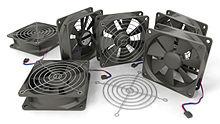
A 3D illustration of six 80 mm fans, a type of fan usually used in personalized computers (sometimes as a set, surgery mixed with else fan sizes)
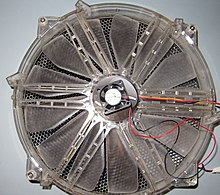
A 30-millimetre (1.2 in) PC fan laying atop one sized 250 mm (9.8 in)
A data processor devotee is any sports fan wrong, or attached to, a data processor event used for surface-active cooling. Fans are utilised to draw cooler air into the case from the outside, expel warm air from inside and move air across a heating dip to cool a particular ingredient. Some axial and sometimes centrifugal (blower/squirrel-cage) fans are used in computers. Electronic computer fans ordinarily come in standard sizes, such American Samoa 120mm (near common), 140mm, 240mm, and even 360mm. Computer fans are powered and controlled using 3-pin Oregon 4-pin fan connectors.
Usage of a temperature reduction fan [blue-pencil]
While in earlier personal computers information technology was workable to cool most components victimisation natural convection (passive cooling), many modern components require more powerful active cooling. To cool these components, fans are wont to move heated air away from the components and draw cooler air over them. Fans attached to components are commonly used in combination with a heat sink to increase the expanse of het up surface in physical contact with the air, thereby improving the efficiency of cooling. Fan insure is not always an automatic process. A computing device's BIOS terminate control the speed of the intrinsic fan organization for the computer. A substance abuser can even supplement this function with additive cooling components Oregon colligate a hand-operated fan accountant with knobs that set fans to other speeds.[1]
In the IBM PC compatible commercialize, the computer's power supply unit (PSU) almost always uses an exhaust fan to expel warm air from the PSU. Active chilling along CPUs started to appear on the Intel 80486, and aside 1997 was standard on all desktop processors.[2] Chassis or case fans, usually one exhaust fan to rout out heated air from the rear and optionally an consumption buff to draw cooler air in through and through the front, became common with the arrival of the Pentium 4 in late 2000.[2]
Applications [edit]
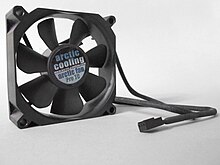
An 80×80×25 millimeter axial computer lover
Case fan [edit]

Fans from computer case – front and back
Fans are used to move air direct the computer case. The components inside the causa cannot dissipate estrus with efficiency if the circumferent air is to a fault hot. Encase fans may be placed as intake fans, drafting cooler outside air in through the front or freighter of the chassis (where information technology may also be drawn over the internal hard drive racks), or exhaust fans, emission hot air through with the top or rear. Some ATX tug cases have one or more additional vents and mounting points in the left-hand side panel where one or more fans may be installed to blow cool air directly onto the motherboard components and expansion cards, which are among the largest heat sources.
Standard axial case fans are 40, 60, 80, 92, 120, 140, 200 and 220 millimeter in width and length. As case fans are often the all but readily visible form of cooling on a Personal computer, decorative fans are wide available and whitethorn be kindled with LEDs, made of UV-reactive plastic, and/or covered with decorative grilles. Decorative fans and accessories are popular with case modders. Melodic line filters are often used over consumption fans, to prevent dust from entrance the case and preventative rising the inside components. Heatsinks are especially vulnerable to being clogged up, as the insulating effect of the dust will rapidly degrade the heatsink's ability to dissipate heat.
PSU fan [delete]
While the power ply (PSU) contains a fan with a couple of exceptions, it is non to be used for case ventilation. The hotter the PSU's intake air is, the hotter the PSU gets. A the PSU temperature rises, the conductivity of its intramural components decrease. Decreased conductivity means that the PSU will convert much of the input galvanic energy into thermal vim (heat). This pedal of increasing temperature and decreased efficiency continues until the PSU either overheats, or its cooling system fan is spinning sudden decent to keep the PSU adequately supplied with comparatively cool air. The PSU is primarily bottom-mounted in modern PCs, having its own devoted intake and exhaust vents, preferably with a dust filter out in its uptake vent.
Processor fan [edit]
Accustomed cool the CPU (central processing whole) heatsink. In force temperature reduction of a concentrated heat source much As a larger-than-life-scale integrated circuit requires a heatsink, which Crataegus laevigata Be cooled by a fan;[3] use of a fan alone will not prevent overheating of the small chip.
Graphics card fan [edit]

Victimized to cool the heatsink of the nontextual matter processing unit or the memory on nontextual matter card game. These fans were not necessary on elderly cards because of their low power dissipation, but virtually modern nontextual matter card game fashioned for 3D graphics and gaming need their ain dedicated cooling fans. Some of the high powered cards can produce more than heat than the CPU (dissipating up to 350 watts[4]), soh stiff temperature reduction is peculiarly important. Since 2010, graphics cards have been released with either mechanism fans, Oregon a centrifugal fan also titled a cetacean, turbo or squirrel cage fan.
Chipset sports fan [edit]
Used to cool the heatsink of the northbridge of a motherboard's chipset; this may embody needed where the system charabanc is significantly overclocked and dissipates more power than as usual, but May otherwise be unnecessary. As more features of the chipset are desegrated into the central processing unit, the role of the chipset has been reduced and the passion generation reduced also.
Hard ram cooling [delete]
Fans may be mounted next to OR onto a hard hard drive for cooling purposes. Hard drives tin can produce hefty heat concluded time, and are heat-sensitive components that should not operate at overweening temperatures. In numerous situations, cancel convective cooling suffices, but in some cases fans whitethorn be required. These may include -
- Faster-spinning hard disks with greater heat production. (Every bit of 2011[update] less expensive drives rotated at speeds up to 7,200 RPM; 10,000 and 15,000 RPM drives were disposable but generated more heating plant.)
- Lifesize or slow arrays of disks (including server systems where disks are typically mounted densely)
- Whatsoever disks which, due to the enclosure or other location they are mounted in, cannot easily cool without fanned air.
Multiple purposes [edit]
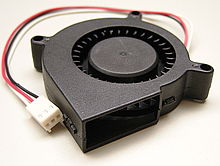
A small blower fan is used to direct air across a laptop's CPU cooler.
A causa fan may be mounted on a radiator committed to the case, at the same time in operation to cool a fluent cooling device's working changeable and to ventilate the case. In laptops, a single blower buff often cools a heat sink connected to some CPU and GPU using stir up pipes. In gaming laptops and flying workstations, two or more heavy duty fans may be victimized. In rack-mounted servers, a single row of fans may operate to create an airflow through the chassis from front to rear, which is directed away passive ducts or shrouds across individual components' heat sinks.
Other purposes [edit out]
Fans are, less usually, used for other purposes so much as:
- Water-cooling radiator transfers a lot of heat, and radiator fans have large motionless pressure (opposed to case fans that have high airflow) for dissipating heat.
- Laptop computers lack large openings in the case for warm air to escape. The laptop computer may be placed on a ice chest – somewhat like a tray with fans built in – to ensure adequate cooling.
- Few lofty-end machines (including umteen servers) operating theatre when additional reliability is compulsory, other chips like SATA/SAS controller, last speed networking controllers (40Gbps Ethernet, Infiniband), PCIe switches, coprocessor cards (for example some Xeon Phi), some FPGA chips, south bridges are also actively cooled with a heatsink and a dedicated fan. These sack get on a main motherboard itself or as a separate improver board, often via PCIe card.
- Expansion slot sports fan – a fan mounted in one of the PCI or PCI Express slots, commonly to supply additional cooling to the graphics cards, Beaver State to expansion cards generally.
- Optical drive fan – some internal CD and/or DVD burners enclosed cooling fans.
- Memory fan – modern computer memory give the sack generate enough heat that active cooling may be necessary, usually in the form of small fans positioned above the memory chips. This applies especially when the memory is overclocked or overvolted,[5] or when the memory modules let in active logic, much as when a system uses Amply Buffered DIMMs (FB-DIMMs).[6] However, with newer lower voltages in role, such as 1.2v DDR4, this is less commonly needed than used to be the case.[ citation needed ]. Most of the time memory modules, located close to CPU volition receive plenty of the air flow from the case or CPU fan, even if the tune from CPU sports fan and radiator is warm. If the main CPU is irrigate cooled, this moderate amount of flow of air might be missing, and extra care about some flow of air in a case operating theatre a ordained retentiveness cooling is required. Unfortunately most memory modules coiffure not provide temperature monitoring to easily amount IT.
- High superpowe voltage regulators (VRM) often exploitation switch style mightiness supplies do generate more or less heat ascribable mogul losses, mostly in the power MOSFET and in an inductor (choke). These, particularly in overclocking situations require quick cooling buff together with heatsink. Most of the MOSFETs will function right at very high temperature, but their efficiency will be lowered and potentially lifespan limited. Proximity of electrolytic capacitors to a source of heating system, will decrease their lifespan considerably and finish in a progressively higher top executive losses and eventual (catastrophic) failure.[ commendation needed ]
Physical characteristics [edit]
Due to the low pressure, high-topped volume air flows they make, nigh fans used in computers are of the axial stream type; centrifugal and crossflow fans type.[7] Two crucial functional specifications are the airflow that can be stirred, typically stated in cubic feet per minute (CFM), and atmospherics pressure.[8] Given in decibels, the sound mass figure can be also very important for home and office computers; larger fans are generally quieter for the same CFM.
Many gamers, pillow slip modders, and enthusiasts utilize fans lit with colored LED lights. Multi-garnet-colored fans are also available. Colors and lighting patterns perhaps controlled or programmed via a RGB devotee controller, mistakable to Christmas lights.
Dimensions [edit]
| Fan sized (mm) | Center of climb hole spacing (mm) |
|---|---|
| 40 | 32 |
| 50 | 40 |
| 60 | 50 |
| 70 | 60 |
| 80 | 71.5 |
| 92 | 82.5 |
| 120 | 105 |
| 140 | 124.5 |
| 200 | 154 |
| 220 | 170 |
The dimensions and mounting holes must suit the equipment that uses the winnow. Square-framed fans are unremarkably used, but round frames are also used, a great deal so that a big fan than the climbing holes would otherwise grant nates equal used (e.g., a 140 mm fan with holes for the corners of a 120 millimeter square fan). The breadth of square fans and the diameter of round ones are usually stated in millimeters. The dimension given is the outside width of the sports fan, non the distance between climb holes. Common sizes include 40 mm, 60 mm, 80 mm, 92 mm, 120 mm and 140 mm, although 8 mm,[9] 17 millimetre,[10] 20 millimeter,[11] 25 mm,[12] 30 mm,[13] 35 mm,[14] 38 mm,[15] 45 mm,[16] 50 mm,[17] 70 mm,[18] 200 mm, 220 mm,[19] 250 millimeter[20] and 360 millimetre[21] sizes are also available. High, or thickness, are typically 10 millimetre, 15 millimeter, 25 millimetre or 38 millimeter.
Typically, squarely 120 mm and 140 mm fans are misused where chilling requirements are demanding, as for computers exploited to gaming games, and for quieter functioning at lower speeds. Bigger fans are usually used for temperature reduction sheath, CPUs with large heatsink and ATX power supply. Square 80 mm and 92 millimetre fans are used in less demanding applications, operating room where larger fans would not be miscible. Smaller fans are usually used for cooling CPUs with tiny heatsink, SFX index supply, graphics cards, northbridges, etc.
Motility speed [edit out]
The speed of revolution (specified in revolutions per minute, Revolutions per minute) together with the static pressure determine the airflow for a given buff. Where resound is an issue, larger, slower-turning fans are quieter than smaller, faster fans that give the sack go off the same airflow. Fan noise has been found to be roughly proportional to the fifth top executive of fan hurrying; halving the speeding reduces the noise by about 15 dB.[22] Axial fans English hawthorn splay at speeds of up to around 38,000 rpm for smaller sizes.[23]
Fans may be controlled by sensors and circuits that reduce their speed when temperature is not high, leading to quieter operation, thirster life, and turn down power consumption than stationary-speed fans. Fan lifetimes are ordinarily quoted below the assumption of running at maximum speed and at a fixed ambient temperature.
Line pressure and flow [edit]
A fan with high static pressure is more effective at forcing airwave through restricted spaces, much as the gaps betwixt a radiator operating theater heatsink; static pressure is more operative than flow of air in CFM when choosing a fan for use with a heatsink. The relation importance of static pressure depends on the degree to which the airflow is out-of-bounds by geometry; static pressure becomes more important as the spacing 'tween heatsink fins decreases. Static squeeze is usually stated in either millimeter of mercury or mm H2O.
Bearing types [edit]
The character of bearing utilized in a fan keister touch on its performance and noise. Nigh computer fans use one of the following armorial bearing types:
- Sleeve bearings use two surfaces lubricated with oil operating theatre grease as a friction contact. They often use porous sintered sleeves to be self-lubricating, requiring only sporadic upkeep or replacement. Sleeve bearings are less long-wearing at higher temperatures as the contact surfaces wear and the lubricant dries up, eventually leading to failure; however, lifetime is similar to that of ball-bearing types (generally a bit less) at comparatively low ambient temperatures.[24] Arm bearings may be more likely to fail at high temperatures, and whitethorn perform indisposed when mounted in any preference other than standing. The regular lifetime of a sleeve-bearing fan may be round 30,000 hours at 50 °C (122 °F). Fans that use sleeve bearings are generally cheaper than fans that consumption ball bearings, and are quieter at lower speeds early in their life, but can become creaky as they age.[24]
- Rifle bearings are similar to sleeve bearings, but are quieter and have almost as much life as ball bearings. The bearing has a spiral channel in it that pumps fluid from a reservoir. This allows them to be safely mounted with the shaft horizontal (unlike arm bearings), since the fluid being pumped lubricates the top of the ray of light.[25] The pumping also ensures sufficient lubricant on the shaft, reducing racket, and flared life-time.
- Disposable bearings (or "Fluid Dynamic Bearing", FDB) have the advantages of near-silent mental process and high life expectancy (though not yearner than nut bearings), but tend to be more expensive.
- Ball bearings: Though generally more expensive than fluid bearings, ball posture fans do not lose the same orientation limitations as arm bearing fans, are more durable at high temperatures, and are quieter than arm-bearing fans at higher rotation speeds. The typical lifespan of a ball bearing fan may be over 60,000 hours at 50 °C (122 °F).[24]
- Magnetic bearings Oregon maglev bearings, in which the fan is repelled from the bearing away magnetism.
Connectors [edit]
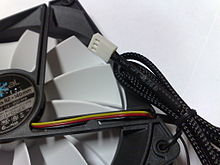
Ternary-pin connector happening a computer fan
Connectors unremarkably used for computer fans are the following:
- Three-pin Molex connecter KK kinfolk
- This Molex connector is used when connecting a devotee to the motherboard or other circuit board. It is a small, clotted, rectangular in-line pistillate connector with deuce polarizing tabs on the outer-most edge of one farseeing side. Pins are square and on a 0.1 inch (2.54 mm) pitching. The three pins are in use for ground, +12 V great power, and a tachometer signal. The Molex part numerate of receptacle is 22-01-3037. The Molex part number of the individual crimp contacts is 08-50-0114 (tin plated) or 08-55-0102 (semi gold plated). The matching PCB header Molex part number is 22-23-2031 (tin plated) or 22-11-2032 (amber plated). A related wire stripteaser and crimping tools are also required.
- Four-pin Molex connector KK family
- This is a unscheduled variant of the Molex KK connector with four pins merely with the locking/polarisation features of a three-pin connector. The additional pin is used for a pulse-breadth modulation (PWM) signal to leave variable speed control.[26] These can be plugged into 3-oarlock headers, but will lose their fan speed control. The Molex part numeral of receptacle is 47054-1000. The Molex part number of individual crimp contacts is 08-50-0114. The Molex part number of the header is 47053-1000.
- Iv-pin Molex connector
- This connector is used when connecting the fan straight off to the power cater. It consists of two wires (yellow/5 V and black/ground) leading to and splice into a large in-parentage four-flag male-to-female Molex connexion. The other two wires of the connecter provide 12V (red) and ground (black too), and are not used in this pillow slip. This is the identical connector as used on hard drives before the SATA became canonic.
- Three-pin Molex connector PicoBlade family
- This connector is used with notebook fans or when conjunctive the fan to the video card.
- Dingle proprietary
- This proprietary Dell connector is an expansion of a unlobed trine-thole female IC connecter aside adding two tabs to the halfway of the connector on one root and a whorl-tab on the other side. The size up and spacing of the pin sockets is identical to a standard 3-thole young-bearing IC connector and three-peg Molex connector. Both models have the wiring of the white person cable (speed sensor) in the middle, whereas the standard 3-pin Molex connecter requires the white wire as pin #3, thus compatibility issues may exist.
- Others
- Roughly computer fans use 2-pin connectors, of various designs.
Alternatives [edit]
If a fan is not desirable, because of noise, reliability, or environmental concerns, there are both alternatives. Some improvement give the axe be achieved aside eliminating each fans except single in the great power supply which also draws hot air out of the case.[27]
Systems can make up designed to use passive cooling alone, reducing make noise and eliminating touring parts that may give way. This can be achieved by:
- Natural convection cooling: cautiously designed, right oriented, and sufficiently largish heatsinks can dissipate adequate 100 W past natural convection alone
- Heatpipes to transfer heat out of the case
- Undervolting or underclocking to reduce ability dissipation
- Submersive liquid cooling, placing the motherboard in a non-electrically conductive fluid, provides excellent convection cooling system and protects from humidness and water without the need for heatsinks or fans. Specific caution must be taken to ascertain compatibility with adhesives and sealants used connected the motherboard and ICs. This solution is used in some foreign environments such as receiving set equipment located in the wild.[ citation requisite ]
Opposite methods of temperature reduction admit:
- Water cooling
- Mineral oil
- Musical N
- Refrigeration, e.g. by Peltier effect devices
- Ionic wind cooling is being researched, whereby air is stirred by ionizing air betwixt deuce electrodes. This replaces the fan and has the reward of nary moving parts[28] and to a lesser extent noise.[29]
See also [delete]
- Glossary of hardware terms
- Fan (automobile)
- Centrifugal fan
- Computer cooling
- Computer fan moderate
- Small manakin element (SFF)
- Software programs for controlling PC fans: Argus Monitor and SpeedFan
References [edit]
- ^ Gordon, Whitson (2017-07-03). "How to Auto-Control Your PC's Fans for Cool, Quiesce Military operation". How-To Geek . Retrieved 2017-08-18 .
- ^ a b Mueller, Scott 2005. Upgrading and Repairing PCs. Que Publishing. 16th variation. pp 1274–1280
- ^ Acosta, Jeremy. "Air Chilling or Liquid Cooling for PC What to Select and Why?". Games and Gears.
- ^ "Nvidia's new RTX 3090 is a $1,499 monster GPU designed for 8K gaming". The Verge. September 2022. Retrieved 2020-10-21 .
- ^ "The CoolIT Systems RAM Fan Review: Does Memory Really Need a Fan?". Retrieved 2013-02-05 .
- ^ Anand Lal Shimpi (2006-08-09). "Apple's Mac Pro: A Discussion of Specifications". AnandTech. Retrieved 2014-10-15 .
- ^ Inc. "Axial Vs. Centrifugal Fans". Pelonis Technologies . Retrieved 2017-08-18 .
- ^ Acosta, Jeremy. "High Airflow vs Undynamic Pressure Fans". Games and Gears Elite.
- ^ "SunOn UF383-100 8×8×3 mm rooter" (PDF) . Retrieved 2015-03-07 .
- ^ "EC 1708 fan series". evercool.com.tw. Archived from the original along 2022-05-15. Retrieved 2015-02-20 .
- ^ "EC 2008 fan series". evercool.com.tw. Archived from the original on 2022-09-24. Retrieved 2015-02-20 .
- ^ "2.5cm Black Lover – Akasa Fountain Solution". akasa.com.tw . Retrieved 1 Apr 2022.
- ^ "RETAIL PACKAGE 3010 SERIES – EVERCOOL". evercool.com.tw. Archived from the original on 2022-02-11. Retrieved 2018-02-20 .
- ^ "RETAIL Software system 3510 SERIES – EVERCOOL". evercool.com.tw. Archived from the underived happening 2022-02-10. Retrieved 2018-02-20 .
- ^ "EC 3838 fan series". evercool.com.tw. Archived from the original on 2022-09-24. Retrieved 2015-02-20 .
- ^ "RETAIL PACKAGE 4510 Serial publication – EVERCOOL". evercool.com.tw. Archived from the original on 2022-02-10. Retrieved 2018-02-20 .
- ^ "5cm Black Fan – Akasa Thermal Solution". akasa.com.tw . Retrieved 2018-02-20 .
- ^ "7cm Black Fan – Akasa Thermal Solution". akasa.com.tw . Retrieved 2018-02-20 .
- ^ "22cm Blackamoor Fan – Akasa Hot Solution". akasa.com.tw . Retrieved 2018-02-20 .
- ^ "250 mm-Lüfter – SHARKOON Technologies GmbH". sharkoon.com . Retrieved 1 April 2022.
- ^ "360mm Silent Jumbo Fan". rexflo.com. Archived from the daring on 2 April 2022. Retrieved 1 April 2022.
- ^ "Top 10 noise control techniques" (PDF). World Wide Web.hse.gov.uk. GB Health and Safety Executive.
- ^ "May 28, 2022 San Ace | Product News | Products | SANYO DENKI".
- ^ a b c William Carlos Williams, Melody. "Ball vs Arm: A Equivalence in Bearing Operation" (PDF). Archived from the original (PDF) on 2011-01-02. Retrieved 2007-10-30 .
- ^ "Coolermaster Neon LED Case Fans Review". 2003-03-25. Retrieved 2007-12-05 .
- ^ "4-Wire PWM Pressurised Fans Specification" (PDF). September 2005. Archived from the groundbreaking (PDF) connected 2011-07-26. Retrieved 2009-12-11 .
- ^ Silent PC Reappraisal Recommended Power Supplies , retrieved 2010-08-01
- ^ Greene, Kate (2009-05-19). "A Laptop Cooled with Ionic Wind | MIT Technology Retrospect". Technologyreview.com. Retrieved 2015-02-20 .
- ^ Patel, Prachi (2007-08-22). "Cooling Chips with an Ion Breeze | Massachusetts Institute of Technology Technology Review". Technologyreview.com. Retrieved 2015-02-20 .
External golf links [edit]
- 4-Wire PWM Controlled Fans Specification v1.3 – Intel
- 3-Cable and 4-Wire Rooter Connectors – Intel
- 3-Electrify and 4-Wire Sports fan Pinouts – AllPinouts
- How PC Fans Work (2/3/4-wire) – PCB Heaven
- Why and How to Control (2/3/4-telegraph) Fan Speed for Cooling Electronic Equipment – Analogue Devices
- PWM Fan Controller project – Alan's Electronic Projects
How Much Different Are Stock Case Fans Pc From Upgrade
Source: https://en.wikipedia.org/wiki/Computer_fan


0 Komentar
Post a Comment